

Word Search - Word Puzzle Game
Bluetile
I enjoy word-search games most when they are easy to start but still give me a reason to return, and Word Search Journey fits that mood well. It is a free word puzzle game from Bluetile, built around the familiar task of finding hidden words in a letter grid. The idea is simple enough for a quick break, yet the format can become surprisingly absorbing when I start chasing difficult placements or trying to scan more efficiently.
What makes it worth considering is not a complicated collection of systems, but the way it turns a quiet vocabulary exercise into a repeatable routine. I can open it for a few minutes, settle into a slower session, or use it as a light mental warm-up before work. Its broad appeal is reflected in an average rating of 4.8 from around 709 thousand ratings, while more than 100 million installs show how comfortably this style of game fits into everyday mobile use.
How I use the game from the first puzzle onward
The baseline workflow is refreshingly clear. I begin with the grid, check the word list, and scan for obvious combinations before dragging across letters. Words may run horizontally, vertically, or diagonally, so I avoid locking myself into one direction too early. The best opening habit is to look for distinctive letters first rather than reading every row from left to right. A rare-looking letter can reveal the location of a longer word much faster than a full grid scan.
Related News

Bridge Race Transformed: Platform Updates Boost Gameplay

Unlocking the Power of YouVersion Bible App's Audio Feature
Once I find a word, I mark it and immediately return to the remaining list. That small reset matters because a discovered word often exposes nearby letters that were visually distracting me. I also try not to search for the shortest word first every time. Short entries can be useful anchors, but longer words usually offer more information about the surrounding grid and can make the rest of the puzzle easier to read.
For a realistic everyday session, I might open the game while waiting for a train or during a short afternoon pause. I do not need to prepare anything, remember a complicated storyline, or commit to a long play period. I can solve one puzzle and stop without feeling that I have abandoned a larger campaign. That makes it more practical than many word games that depend heavily on streaks, timers, or a constant stream of competitive pressure.
Related News

Why WhatsApp Messenger Still Makes Everyday Communication Feel Easy

Jurassic World: The Game Is the Better Dino Tycoon for Strategic Players

Threads in Real Life: Who Should Join, Lurk, or Leave

How SHEIN Turned Shopping Into an Endless Content Feed

How to Make Fortnite Feel Smarter on Mobile

Should You Switch to Microsoft Outlook on Mobile?
The game is also approachable for people who do not normally play mobile games. The basic interaction is familiar: identify a word and trace it through the grid. Someone who enjoys printed puzzle books will understand the appeal immediately, while a younger player can use it as a gentle way to practice spelling and visual recognition. The Everyone content rating supports that broad audience, although younger players may still benefit from occasional help with unfamiliar vocabulary.
I would not describe every puzzle as equally relaxing. When several words share similar letter patterns, the screen can become visually noisy, and a session that began as a calm break can turn into a determined search. That tension is part of the fun, but it is worth knowing if you want a completely passive experience. This is a game that asks for attention, even when the rules remain simple.
Small habits that make the basic loop better
My most useful habit is to divide the grid into zones instead of scanning it as one large picture. I check the upper area, middle area, and lower area, then move through likely starting letters inside each zone. This reduces the chance of repeatedly checking the same rows. It also helps when I return to a puzzle after a distraction because I can resume from a clear visual section rather than starting over mentally.
Gallery
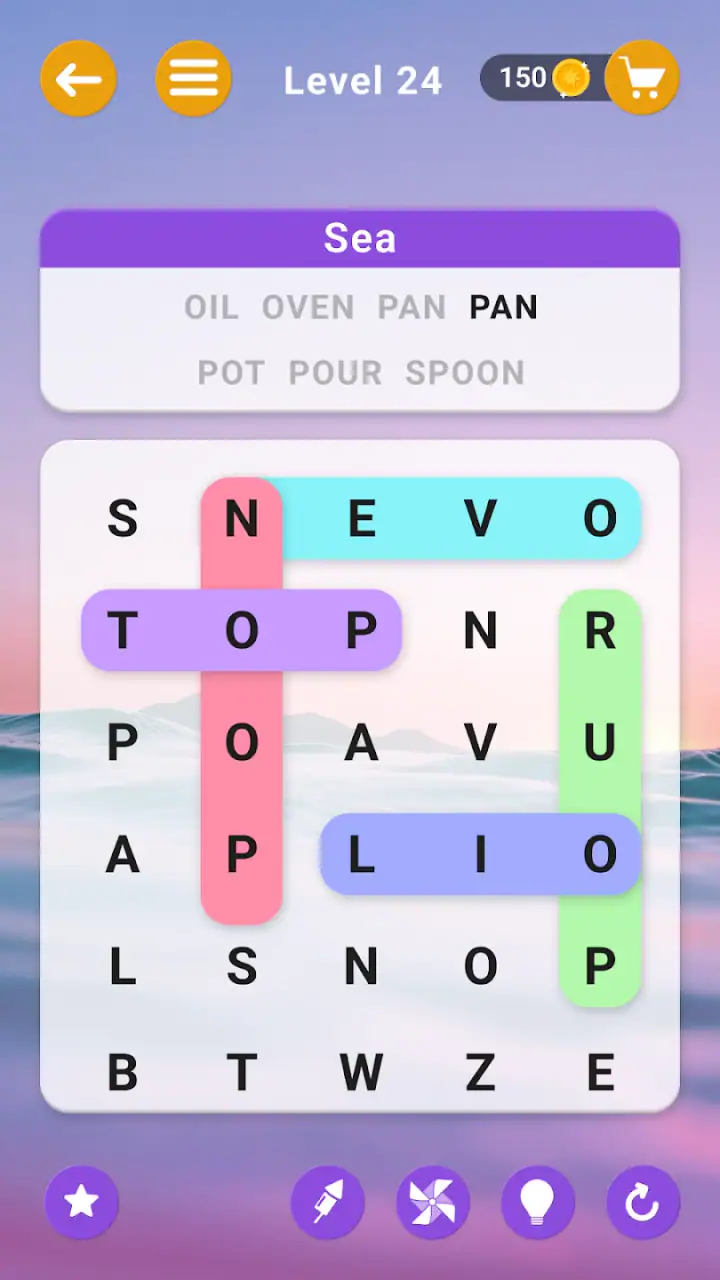
I also read the target list for unusual letter combinations. If a word contains a pair of letters that rarely appears together, I search for that pair first. If the list contains several words with the same beginning, I look for the shared opening and then compare their endings. These are simple techniques, but they change the experience from random staring into a manageable process.
Another practical trick is to rotate my attention between the word list and the grid. Staring only at the letters makes patterns blur together. Reading only the list leaves me with no useful search direction. Switching between the two every few seconds keeps the puzzle active without making it feel rushed.
Settings and accessibility choices worth checking
Before settling into regular play, I recommend spending a moment checking the available settings rather than accepting the default experience automatically. The most useful choices in a word-search game are usually the ones that affect comfort: sound, notifications, visual presentation, and how much assistance is available when I am stuck. I do not change everything at once. I adjust one option, play a puzzle, and decide whether it improves concentration or simply adds distraction.
Sound is a personal decision. I prefer quieter sessions when I am playing in a waiting room or beside someone else, while light feedback can make successful finds feel more satisfying at home. If the game begins to compete with the words on screen, reducing sensory clutter is more valuable than chasing a more exciting atmosphere.
Notifications deserve the same practical treatment. A word puzzle is easy to return to without constant reminders, so I would keep only the alerts that genuinely help me remember the game. If notifications interrupt work or reading, turning them down makes the app feel more like a tool I control rather than another source of noise.
Visual comfort matters especially during longer searches. I keep the phone at a readable distance and avoid playing with glare across the grid. A bright reflection can make similar letters harder to distinguish, which feels like a gameplay problem even though it is really a viewing problem. Taking a short pause and changing the angle of the screen can be more effective than forcing another minute of scanning.
The current version is 3.8.4 and runs on Android 7.0 or later, so compatibility should be comfortable for many older Android devices as well as newer ones. I still recommend checking the device experience before committing to long sessions, particularly if the phone has a small display. A dense letter grid is naturally easier to read on a larger screen, and that is a physical limitation no setting can completely remove.
Because the game is free to download, it is easy to try without an upfront purchase. It does include optional in-app purchases ranging from $0.99 to $19.99 per item. I see that as a reason to decide on a personal spending boundary before playing regularly. The core appeal is the puzzle loop, so I would not treat purchases as necessary for someone who simply wants occasional word searches. Players who dislike any form of optional spending prompt should be more cautious than those who are comfortable ignoring extras.
Making the screen work for your playing style
For relaxed play, I focus on a comfortable pace and allow myself to pause when the grid becomes tiring. For vocabulary practice, I keep a note of words I do not recognize and look at their spelling after the session. That turns an otherwise disposable puzzle into a small learning exercise. I would not rely on the game as a complete language course, but it can support repeated exposure to words in a more engaging way than memorizing an isolated list.
For family use, I prefer taking turns rather than having one person grab the phone and solve everything. One player can read the target word while another searches, then they can switch roles. This makes the visual scanning process easier to discuss and gives less experienced players time to develop their own methods. Since the rules are so accessible, the game works better as a shared observation activity than as a test of who can tap fastest.
How experienced play becomes faster without becoming frantic
Speed in this game comes mainly from reducing wasted attention. I begin by identifying the first and last letters of each target word, then search for those letters in the grid. If a word is long, I check the most distinctive end first. If several targets share a common ending, I search for the beginning instead. This approach is more reliable than sweeping across every row, especially when the grid contains many repeated vowels.
I also use crossing information. When I find one word, I study the letters it passes through because those same letters may belong to another target. A marked path can therefore become a guide for the next search rather than something I simply forget. The useful trade-off is that I spend a little more time examining an existing find, but I often avoid scanning the whole board again.
Direction changes are another source of wasted time. I try to decide whether a target is likely to run in a straight line before tracing it. Searching forward and backward mentally is important because a word does not need to appear in the reading direction I expect. When I repeatedly miss an obvious word, I reverse the search direction instead of assuming the letters are absent.
For difficult boards, I use a two-pass method. The first pass finds only the words that stand out immediately. The second pass is slower and focuses on the remaining list, using known letters and likely directions. This prevents one stubborn target from consuming the entire session and gives me a clearer picture of what is actually left.
These habits are especially useful for people who play during short breaks. If I have only a few minutes, I can make meaningful progress without rushing every move. I solve the obvious entries first, leave the harder search in a known state, and return later with a fresh visual perspective. That is one of the quiet strengths of a non-story-driven puzzle: stopping does not damage my understanding of a narrative or leave me worried about losing a complicated chain of progress.
Where the familiar format starts to show its limits
The same simplicity that makes Word Search Journey welcoming can also limit its appeal. If you want deep strategy, character development, competitive rankings, or a strong sense of progression, this is probably not the right destination. The satisfaction comes from recognition and completion, not from building a long-term game plan. I enjoy that restraint, but I would not recommend it to someone who needs constant novelty or a rich reward structure.
It is also not an ideal choice for players who dislike visual repetition. Word-search puzzles naturally ask me to inspect similar rows and columns many times, and no clever method removes that completely. The game can improve my scanning habits, but it cannot transform the basic activity into something radically different from a traditional word-search book.
Another trade-off concerns vocabulary. Familiar words make the experience smooth, while less familiar ones can create a useful challenge. However, when I do not know a word, the puzzle may feel like a recognition test rather than a pure search exercise. That is good for curiosity and spelling practice, but frustrating if I want every answer to be immediately understandable.
Players who prefer a fully offline-feeling, distraction-free puzzle book may prefer a dedicated alternative with no optional purchase prompts or broader customization. On the other hand, someone who wants a ready-to-open digital version with a huge existing audience may find this game more convenient than carrying a printed collection. The better choice depends less on skill and more on how much surrounding mobile-game structure you are willing to accept.
Who should play it and who should skip it
I recommend this game to casual puzzle fans, vocabulary learners, families looking for a simple shared activity, and anyone who wants a low-pressure way to occupy small gaps in the day. It is particularly suitable for players who appreciate clear rules and gradual improvement. The free entry point makes trying it straightforward, while the Everyone rating keeps the intended audience broad.
I would be more selective for people who need large text, highly specialized accessibility controls, or a very competitive experience. A letter grid can be demanding on a small screen, and players with visual fatigue may need shorter sessions and careful screen positioning. Likewise, anyone seeking a game with a strong social layer or a dramatic sense of achievement may find the format too contained.
The developer, Bluetile, has created something that succeeds by staying focused. I do not open it expecting a new genre or an elaborate surprise. I open it because finding words is satisfying, easy to understand, and flexible enough to fit around real life. The fact that it has accumulated over 15 thousand written reviews alongside its large rating base suggests that the simple format has connected with a substantial number of players, though popularity alone does not remove the limitations of the genre.
My verdict after building a repeatable routine
After using the game as both a quick distraction and a more deliberate vocabulary exercise, I see its strongest quality as dependable simplicity. Word Search Journey is at its best when you want a focused five-minute reset rather than a demanding gaming commitment. It rewards better scanning habits, gives me enough challenge to stay engaged, and does not require a complicated tutorial before the first useful moment.
The practical way to get more from it is to treat each puzzle as a small visual workflow: check the target list, search distinctive letters, divide the grid into zones, use found words as clues, and pause before frustration turns into blind scanning. Those habits make the experience feel more skillful without pretending that the underlying format is deeper than it is.
I would choose it over a printed puzzle book when I want convenience, quick access, and a game that is already suited to short mobile sessions. I would choose a more specialized word-learning app when my main goal is structured language study, and a richer puzzle game when I want varied mechanics or a stronger sense of progression. For the right player, though, that narrow focus is exactly why it works.
My final recommendation is positive, with realistic expectations. Try it if you like word searches, want a calm mental break, or enjoy improving through small repeatable techniques. Skip it if repeated grid scanning feels tedious or if optional purchases and mobile-game presentation are deal-breakers. For everyone else, this free word game from Bluetile is an easy companion to keep nearby when I want to relax, sharpen my attention, and finish a satisfying puzzle without turning the moment into a major commitment.
FAQs for Word Search - Word Puzzle Game
What is the main objective of Word Search - Word Puzzle Game?
The main objective of Word Search - Word Puzzle Game is to find and highlight all the hidden words in a grid of letters. Players must locate these words, which can be arranged in various directions, including horizontally, vertically, and diagonally. It's a fun way to challenge your vocabulary and improve your word recognition skills.
Does Word Search - Word Puzzle Game require an internet connection?
No, Word Search - Word Puzzle Game can be played offline. This makes it an excellent choice for those who want to enjoy a game during travel or in areas with limited internet access. However, some features, like leaderboards or in-app purchases, may require a connection.
Are there different difficulty levels in the game?
Yes, Word Search - Word Puzzle Game offers various difficulty levels to cater to different skill sets. Beginners can start with easy puzzles, while seasoned players can challenge themselves with more complex grids. This ensures the game remains engaging and rewarding for all players.
Is Word Search - Word Puzzle Game suitable for all age groups?
Absolutely! Word Search - Word Puzzle Game is designed to be family-friendly and suitable for all age groups. The game helps improve vocabulary and cognitive skills, making it an educational and entertaining choice for kids, while still providing a satisfying challenge for adults.
Are there any in-app purchases or ads in the game?
Word Search - Word Puzzle Game is free to download and play, but it may contain ads to support development. There are also optional in-app purchases available, such as ad-free experiences or additional puzzle packs, for those who want to enhance their gameplay experience.
Pros
- Challenging puzzles improve vocabulary.
- Variety of themes keeps gameplay fresh.
- Offline mode available for play anywhere.
- Daily challenges boost engagement.
- User-friendly interface enhances experience.
Cons
- Contains ads that may interrupt play.
- Limited hints in free version.
- Repetitive music can be distracting.
- Some puzzles may be too easy for experts.
- In-app purchases can be pricey.


